
Description
Bis-PCBM (SOL5062) – High open-circuit voltage (Voc) Electron Acceptor
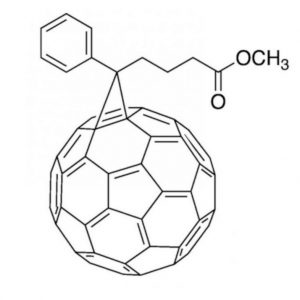
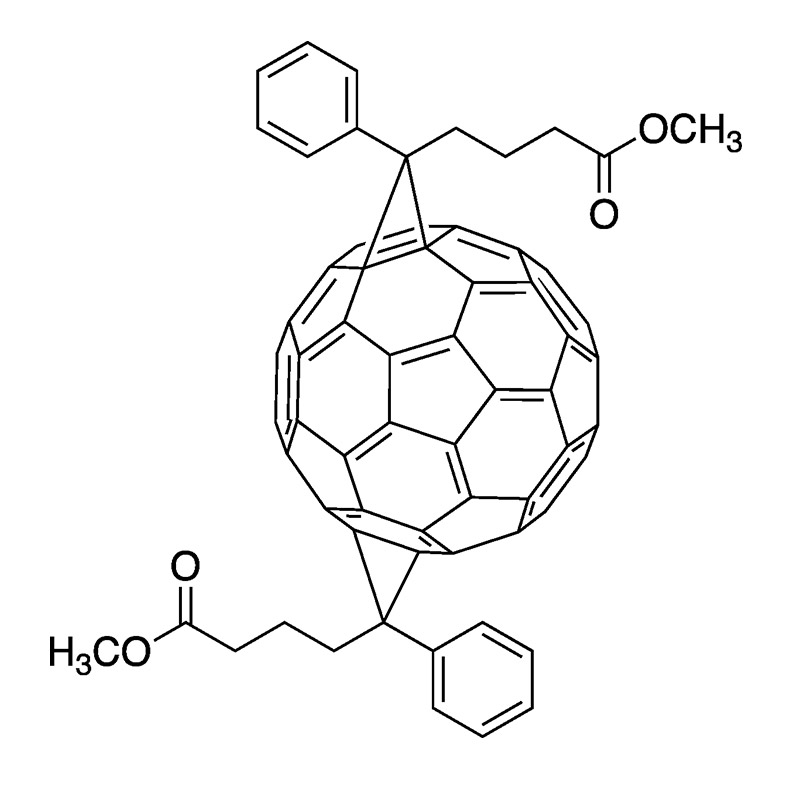
Bis-PCBM (SOL5062, CAS: 1048679-01-1), or [6.6] Diphenyl C62 bis(butyric acid methyl ester), is an advanced fullerene bisadduct electron acceptor engineered for organic photovoltaics (OPV). Supplied by Solaris Chem with >99.9% [6,6] isomer purity, Bis-PCBM provides a higher LUMO energy level (−3.6 eV) than standard mono-PCBM, enabling higher open-circuit voltage (Voc) and superior power conversion efficiency (PCE) in polymer solar cells.
Key Advantages of Bis-PCBM
- Enhanced Open-Circuit Voltage (Voc): A higher LUMO energy level (−3.6 eV vs −3.7 eV for mono-PCBM) reduces energetic loss to maximize cell Voc.
- High Isomer Purity (>99.9% [6,6]): Ensures consistent film morphology, reproducible domain separation, and efficient charge transport.
- Superior Organic Solubility: Soluble in common processing solvents like chloroform, chlorobenzene, toluene, and xylenes for solution-processed solar cells.
- Large-Scale Availability: Produced under strict Canadian quality control standards to support both R&D and industrial scale-up projects.
Available High-Purity Grade
- Grade > 99.50% (SOL5062A): Ultra-pure bisadduct grade optimized for high-efficiency solar cell fabrication and advanced research.
Synergistic Compatibility with Donor Materials
Bis-PCBM (SOL5062) is optimized for pairing with benchmark polymer donor materials to construct high-performance bulk heterojunction (BHJ) active layers:
- P3HT (SOL4106): Poly(3-hexylthiophene-2,5-diyl) for reliable, high-voltage baseline solar cell research.
- PCDTBT (SOL4280): PCDTBT polymer for high-voltage, thermally stable device configurations.
- PTB7 (SOL4700): High-efficiency donor polymer for advanced inverted photovoltaic architectures.
Technical Documentation & SDS
Safety Data Sheet:
Download SDS-SOL5062 (PDF)
Bis-PCBM (SOL5062) Technical Specifications
| Property | Specification / Value |
|---|---|
| Acronyms | Bis PC62BM, Bis PC61BM, Bis[60]PCBM, Bis-PCBM, PC60BM bisadduct |
| Chemical Name | Bis(1-[3-(methoxycarbonyl) propyl]-1-phenyl)-[6.6]C62 ; [6.6] Diphenyl C62 bis(butyric acid methyl ester) |
| CAS Number | 1048679-01-1 |
| Appearance & Texture | Black to brown crystalline powder |
| Molecular Weight | 1,101.12 g/mol |
| HOMO Energy Level | -6.0 eV |
| LUMO Energy Level | -3.6 eV |
| Melting Point | > 300 °C (> 572 °F) |
| Isomer Purity | > 99.9% [6,6] isomerized |
| Solubility Profile | Chloroform, Chlorobenzene, Toluene, Xylenes |
Peer-Reviewed Scientific Citation
“Fullerene Bisadducts for Enhanced Open-Circuit Voltages and Efficiencies in Polymer Solar Cells”
Authors: M. Lenes, G. J. A. H. Wetzelaer, F. B. Kooistra, S. C. Veenstra, J. C. Hummelen, P. W. M. Blom.
Journal: Adv. Mater., 2008, 20, 2116.
Frequently Asked Questions (FAQ) – Bis-PCBM (SOL5062)
What is the primary advantage of Bis-PCBM (SOL5062) over standard mono-PCBM in solar cells?
Bis-PCBM features a higher-lying LUMO energy level (-3.6 eV compared to -3.7 eV for mono-PCBM). This energetic shift increases the open-circuit voltage (Voc) and overall power conversion efficiency (PCE) in polymer bulk heterojunction solar cells.
Which donor materials are compatible with Bis-PCBM (SOL5062)?
Bis-PCBM is widely paired with donor materials such as P3HT (SOL4106), PCDTBT (SOL4280), and PTB7 (SOL4700) to fabricate high-voltage, high-efficiency organic photovoltaics.
What is the solubility and isomer purity of Solaris Chem’s Bis-PCBM?
Solaris Chem supplies Bis-PCBM with >99.9% [6,6] isomer purity. It exhibits excellent solubility in organic solvents including chloroform, chlorobenzene, toluene, and xylenes.
Request pricing for larger quantity
* Price subject to change without prior notice.
Notice: Products for Research and Development. Laboratory use only by qualified personnel. The user should read the available SDS and be aware of any precautions to take for the safe manipulation of these materials. Solaris Chem shall not be held responsible for any damage resulting from handling or use.