
Description
Tris-PCBM (SOL5063) – High LUMO Fullerene Trisadduct for Voltage Maximization
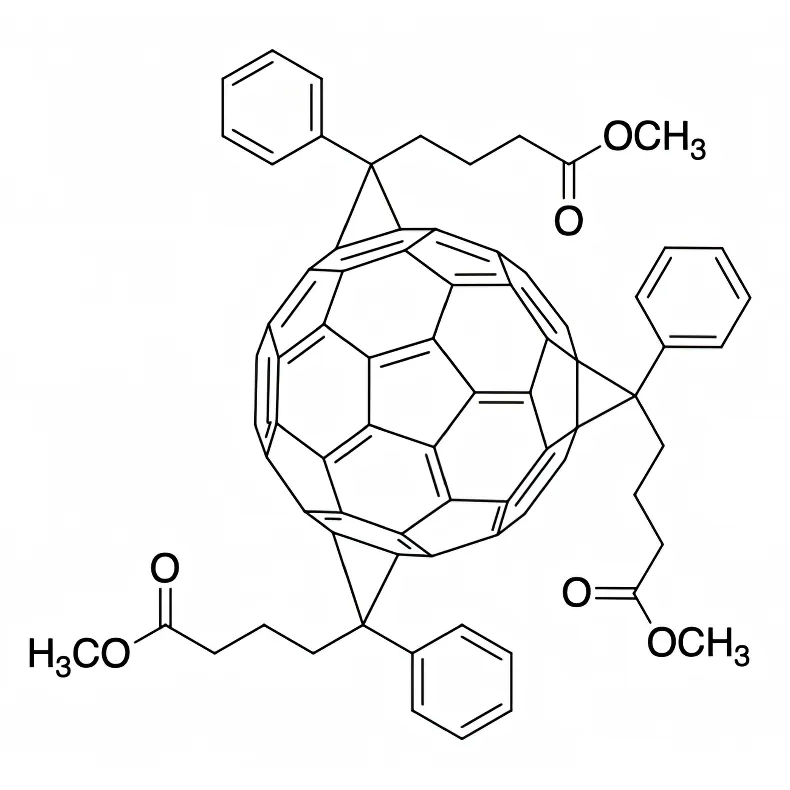
Tris-PCBM (SOL5063), or tris[60]PCBM, is a highly functionalized C60 fullerene trisadduct engineered to minimize charge transfer energy loss in organic photovoltaics (OPV). Supplied by Solaris Chem with >99.9% [6,6] isomer purity, SOL5063 features an elevated LUMO energy level (−3.6 eV) that significantly increases open-circuit voltage (Voc) in bulk heterojunction (BHJ) solar cells and tandem cell architectures.
The Tris-Adduct Advantage: Elevating the LUMO Level
- Reduction of Energetic Losses: Incorporating three adducts onto the carbon cage pushes the LUMO level to −3.6 eV (compared to ~ −3.9 eV for mono-PCBM), substantially reducing energetic drops during electron transfer.
- Voltage Maximization: Directly broadens the energetic gap between the donor polymer HOMO and fullerene LUMO, pushing open-circuit voltage (Voc) toward its theoretical ceiling.
- Ideal for Wide-Bandgap Donors: Delivers exceptional performance when paired with deep-HOMO donor polymers where conventional acceptors cause excessive voltage loss.
Available High-Purity Grades
- Grade > 99.50% (SOL5063A): Standard high-purity trisadduct grade for device optimization and photophysics testing.
- Grade > 99.90% (SOL5063B): Ultra-high purity trisadduct grade for record-setting efficiency attempts and precise interface studies.
Applications & Donor Compatibility in OPV Systems
Tris-PCBM (SOL5063) is a vital benchmark material for studying energetic disorder and charge transport in:
- Bulk Heterojunction (BHJ) Solar Cells: Fine-tunes the energy cascade to maximize power conversion efficiency (PCE).
- Tandem Cell Architectures: Functions as a selective acceptor layer to balance voltage and current across sub-cells.
- Photophysics & Interface Research: Utilized to analyze exciton dynamics and suppress charge recombination.
Optimal Pairing with Solaris Chem Donor Polymers:
- P3HT (SOL4106): P3HT polymer for achieving higher voltages in classic benchmark architectures.
- PCDTBT (SOL4280): PCDTBT polymer optimized for maximum stability and high voltage output.
- PTB7 (SOL4700): Ideal for inverted cell architectures aiming to minimize energy loss.
Technical Documentation & SDS
Safety Data Sheet:
Download SDS-SOL5063 (PDF)
Tris-PCBM (SOL5063) Technical Specifications
| Property | Specification / Value |
|---|---|
| Acronyms | Tris PC63BM, tris[60]PCBM, tris-PCBM, PC60BM trisadduct |
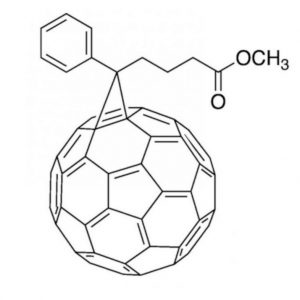
| Chemical Name | Tris(1-[3-(methoxycarbonyl) propyl]-1-phenyl)-[6.6]C63 ; [6.6] triphenyl C63 tris(butyric acid methyl ester) |
| CAS Number | N/A |
| Appearance & Texture | Black to brown powder |
| Molecular Weight | 1,291.24 g/mol |
| HOMO Energy Level | -5.5 eV |
| LUMO Energy Level | -3.6 eV |
| Melting Point | > 300 °C (> 572 °F) |
| Isomer Purity | > 99.9% [6,6] isomerized |
| Solubility Profile | Chloroform, Chlorobenzene, Toluene, Xylenes |
Peer-Reviewed Scientific Citation
“Energetic Disorder in Higher Fullerene Adducts: A Quantum Chemical and Voltammetric Study”
Authors: Jarvist Moore Frost, Mark Anton Faist, Jenny Nelson.
Journal: Adv. Mater. 2010, 22, 4881–4884.
Frequently Asked Questions (FAQ) – Tris-PCBM (SOL5063)
What is the primary technical advantage of Tris-PCBM (SOL5063) over mono- and Bis-PCBM?
Tris-PCBM incorporates three functional groups onto the C60 carbon cage, pushing its LUMO energy level closer to the vacuum (-3.6 eV vs -3.9 eV for mono-PCBM). This significantly reduces energetic voltage loss during electron transfer and directly increases the open-circuit voltage (Voc) of organic photovoltaic devices.
Which donor materials offer optimal compatibility with Tris-PCBM?
Tris-PCBM is ideal for pairing with wide-bandgap and deep-HOMO donor polymers, including P3HT (SOL4106), PCDTBT (SOL4280), and PTB7 (SOL4700), to maximize energy cascade efficiency in solar cells.
In what advanced OPV architectures is Tris-PCBM primarily used?
Tris-PCBM is extensively utilized in bulk heterojunction (BHJ) solar cells, tandem solar cell sub-layers, and photophysics research focusing on exciton dynamics and charge recombination minimization.
Request pricing for larger quantity
* Price subject to change without prior notice.
Notice: Products for Research and Development. Laboratory use only by qualified personnel. The user should read the available SDS and be aware of any precautions to take for the safe manipulation of these materials. Solaris Chem shall not be held responsible for any damage resulting from handling or use.